One camera, five rooms: why vorluno.dev is a route, not a page
InteractiveMotionWebsiteMobile
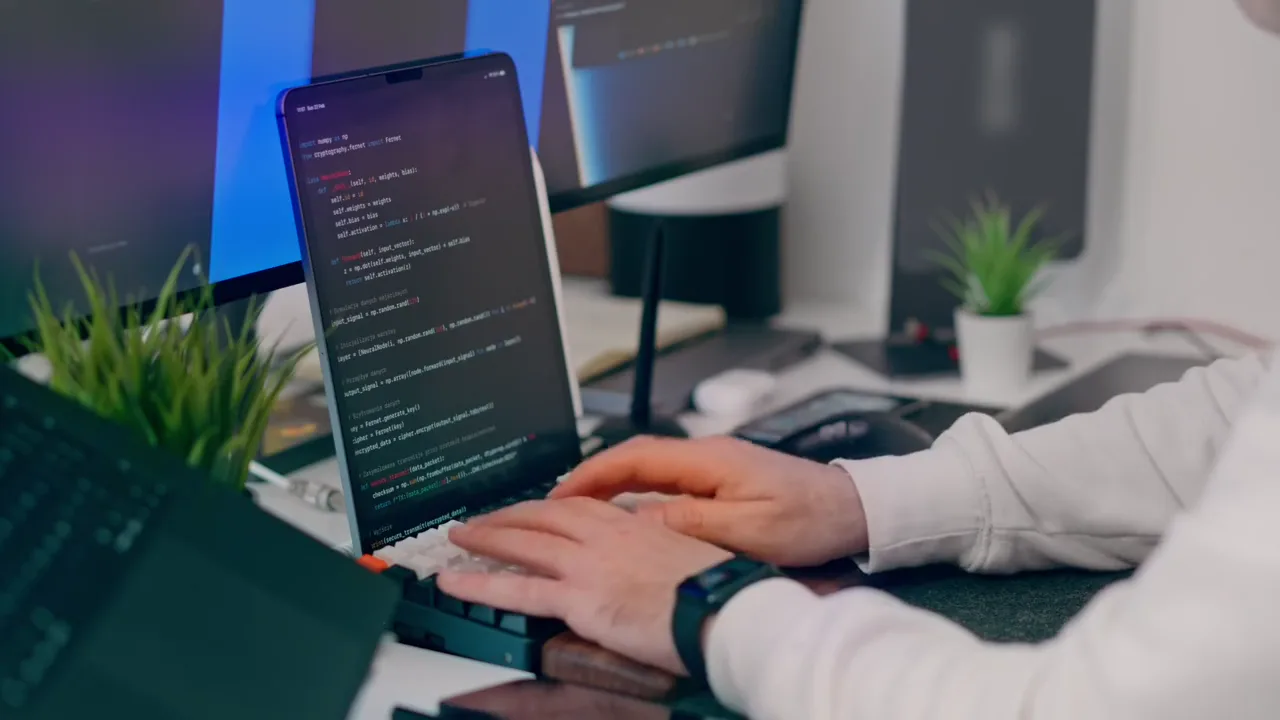
After the tunnel, the camera keeps going — sideways. Five rooms, one for each thing the studio does, and the scroll is the walk between them. On a phone it is the same walk, composed for a taller window.
A page stacks. A route moves. We did not want «what we do» to be four cards in a row; we wanted the feeling of being taken from one room to the next by someone who knows the building. So when the tunnel ends in clean paper, the same camera turns and travels along x, and each room is a group of planes at different depths — a numeral far away, the text at arm's length, the piece up close.
Plateaus, not stops
The camera never halts mechanically. Each room is a plateau in the scroll: the travel takes most of the distance and the plateau the rest, and both ends of the travel are slowed with the same symmetric ease. You arrive the way a heavy dolly arrives. Between rooms, a giant glyph far behind and a card from the stack close in front pass at different speeds — the parallax is what tells your eye the space is real.
The second room is a wall. Ink-dark, edge to edge, with the engineering statement on it and a video that only plays while you are in the room. The nav notices the wall and turns to bone so it stays readable. Leave the room and it goes back to ink.
The same route on a phone
The easy move for mobile is to give up: turn the route into a list. We tried it and it looked like a different, worse site. So on a phone the world is the same — the same camera, the same rooms, the same travel — but each room is composed vertically: index on top, text under it, the piece below, stacked from measured heights so nothing overlaps whatever the copy length or the screen. The route is the product; the phone gets the product.
Read the case, then come back to the same room
The /work route uses the same camera for six projects. Each stop has a wall in the project's own colour, its name in its own typeface, the three blocks — problem, built, measured — and the piece playing on its own. Open a case, read it, press back: the route drops you in the room you left, without replaying the journey. Small, and the kind of thing you only notice when a site gets it wrong.
// Experience itWalk the route on /work