Motion, taken apart: how Vorluno built mvoom to read a website's movement and hand it to AI as numbers
MotionAIProductmvoom
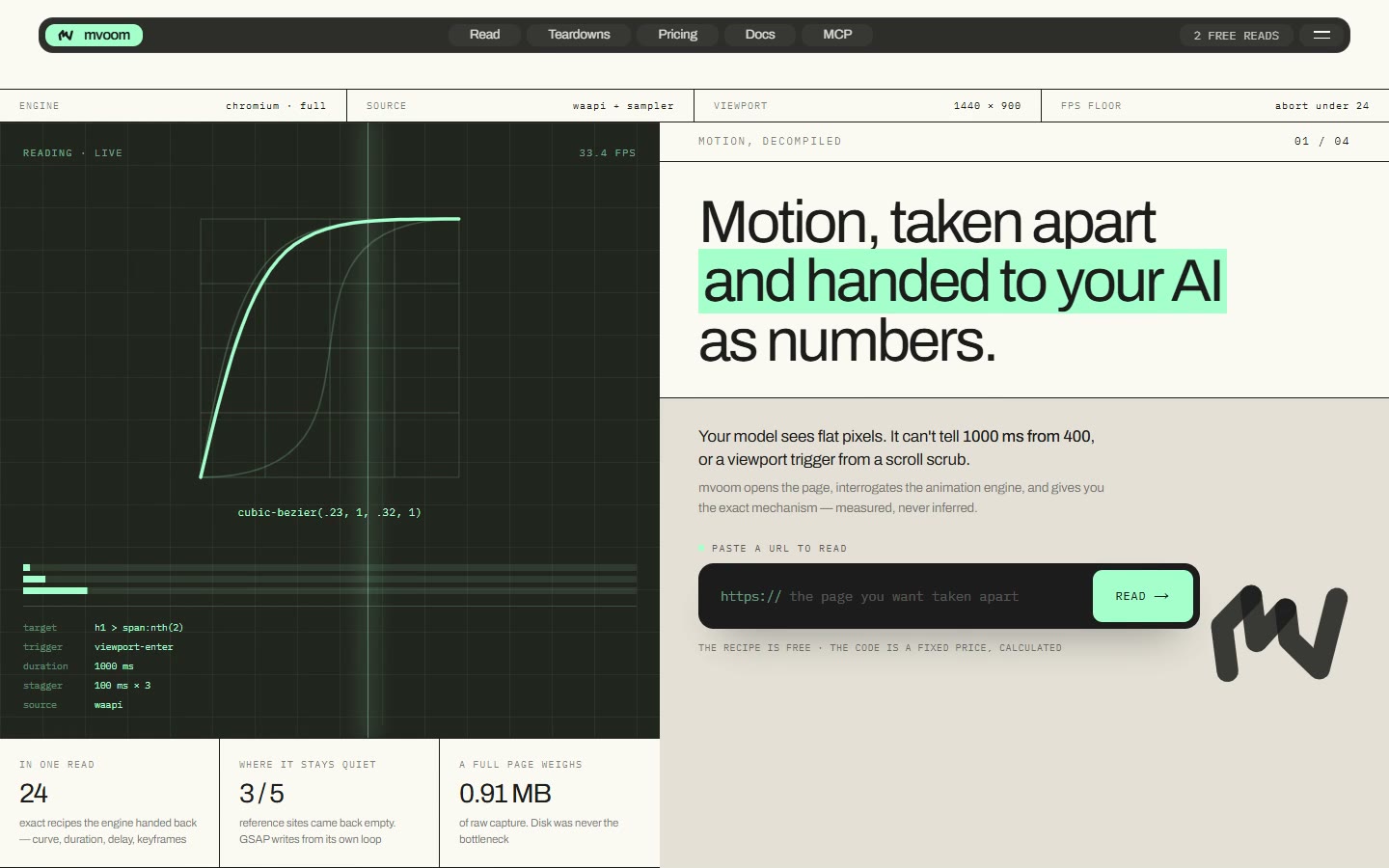
A landing page moves and you feel it in a second. Describing that feeling to a machine used to take a paragraph and a guess. mvoom replaces the guess with a measurement.
Every site we admire has a rhythm you can feel before you can name it. A hero that settles instead of snapping. A list that arrives one line at a time, each line a beat behind the last. When a client says «I want it to feel like that», they mean the rhythm — and until now the only honest answer was to open the site, watch it thirty times, and guess the numbers.
mvoom is the machine that stops guessing. You paste a URL. It opens the page in a real browser, asks the animation engine what it is actually running, and takes the motion apart: which elements move, when, for how long, along which curve, staggered by how much. Then it hands that to an AI as numbers, so the next thing you build can be measured against the thing you liked.
What it sees that a screenshot cannot
A screenshot has no time in it. mvoom gives you the exact numbers the page is using: durations in milliseconds, easing curves as cubic-béziers you can paste into a stylesheet, staggers as the delay between siblings — and then shows you the piece running on those numbers, so you can check one against the other. That is the difference between «make the cards fade in» and «900 ms, cubic-bezier(0.16, 1, 0.3, 1), 30 ms apart». The second one ships.
Fifty probes before every release
Motion extraction is easy to get almost right, which is the dangerous kind of right. So mvoom carries fifty end-to-end probes — real pages, run through the whole pipeline before every release. If a change makes the engine read a page differently from what a probe expects, the release stops there.
The same engine recorded this site
Every video on vorluno.dev — the pieces in the stack, the cases in the route — was recorded by mvoom's render engine: the same browser, the same scroll, sixty frames a second, no hand-held camera and no colour grading. We could have staged them. We preferred the videos to be the product doing its job.
mvoom also lives where the work happens. There is an SDK and a CLI for scripts and pipelines, and an MCP server so an agent in your editor can ask «how does this page move?» and get the numbers back inside the conversation. Motion as a measurement, available wherever you write code.
// Experience itOpen mvoom.com